Thursday, April 4, 2013

The Fates

Moirai:
  • Clotho (pron.: /ˈklθ/, Greek Κλωθώ [klɔːˈtʰɔː] – "spinner") spun the thread of life from her distaff onto her spindle. Her Roman equivalent was Nona, (the 'Ninth'), who was originally a goddess called upon in the ninth month of pregnancy.
  • Lachesis (pron.: /ˈlækɨsɪs/, Greek Λάχεσις [ˈlakʰesis] – "allotter" or drawer of lots) measured the thread of life allotted to each person with her measuring rod. Her Roman equivalent was Decima (the 'Tenth').
  • Atropos (pron.: /ˈætrəpɒs/, Greek Ἄτροπος [ˈatropos] – "inexorable" or "inevitable", literally "unturning",[16] sometimes called Aisa) was the cutter of the thread of life. She chose the manner of each person's death; and when their time was come, she cut their life-thread with "her abhorred shears".[17] Her Roman equivalent was Morta ('Death').
Nemesis: the spirit of divine retribution against those who succumb to hubris (arrogance before the gods). Another name was Adrasteia, meaning "the inescapable."[1] The Greeks personified vengeful fate as a remorseless goddess: the goddess of revenge. The name Nemesis is related to the Greek word νέμειν [némein], meaning "to give what is due".[2

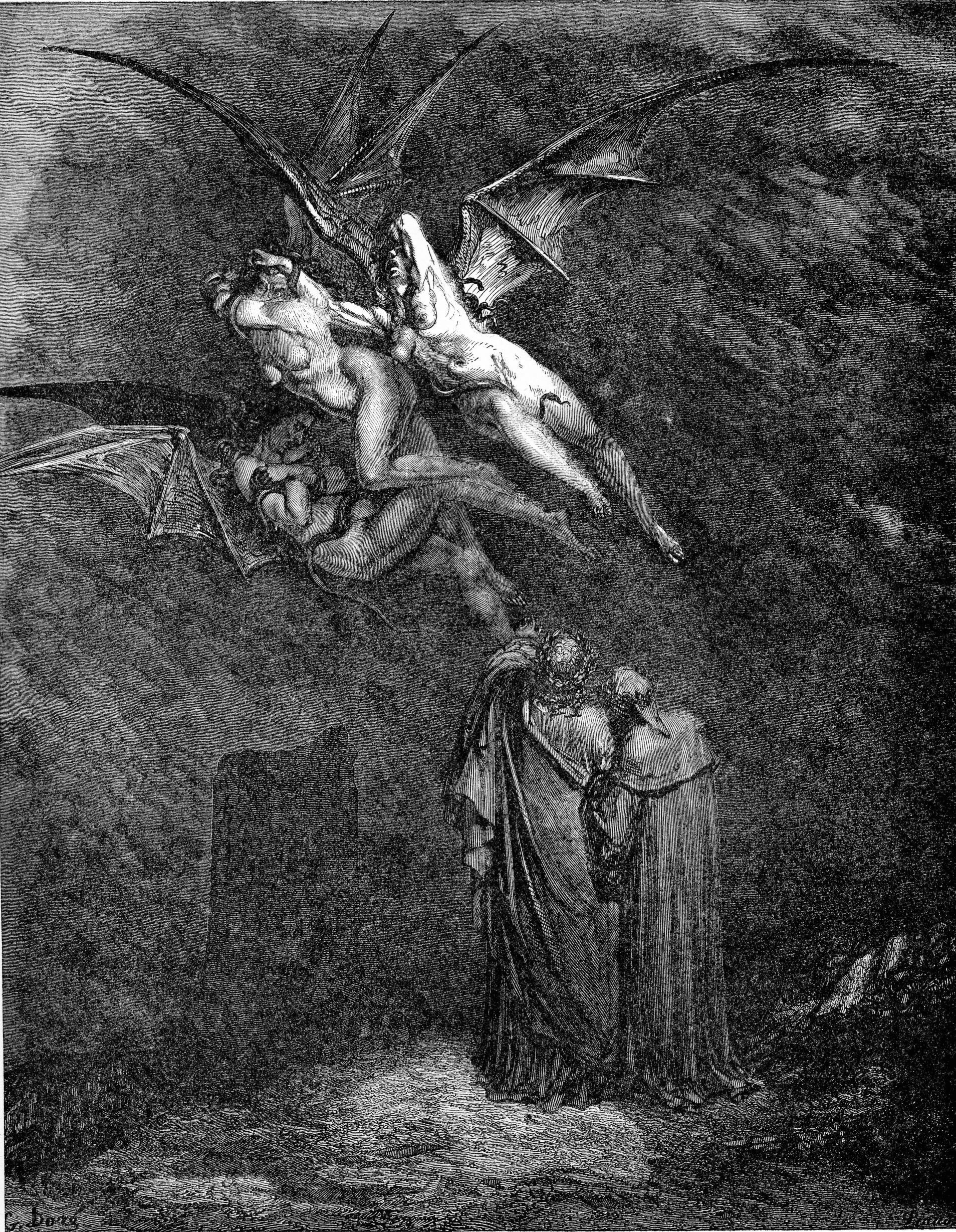
 Erinyes: literally "the avengers" from Greek ἐρίνειν "pursue, persecute" [sometimes referred to as "infernal goddesses" (Greek χθόνιαι θεαί)]) were female chthonic deities of vengeance.
File:DVinfernoMegaeraTisifphoneAlecto m.jpg

Neurolinguistic Programming

Neuro-linguistic programming (NLP) is an approach to communication, personal development, and psychotherapy created by Richard Bandler and John Grinder in California, USA in the 1970s.

Is a system of language patterns for persuasion. The concept was devised by Robert Dilts who modelled the argument and persuasion skills of Richard Bandler (the co-founder of Neuro-linguistic programming). By breaking down the methods, Dilts came up with 14 original patterns. As with other facets of the NLP system, the intention behind formalising the study of influence is to allow people to understand the process, and to duplicate those skills through the direct application of one or more of the Sleight Of Mouth patterns. The name "Sleight of Mouth" builds off the phrase "Sleight of Hand" which refers to a magician's skills in making things happen which appear impossible.

Jonathan Edwards accidentally discovered the techniques during a religious crusade in 1735 in Northampton, Massachusetts. By inducing guilt and acute apprehension and by increasing the tension, the "sinners" attending his revival meetings would break down and completely submit. Technically, what Edwards was doing was creating conditions that wipe the brain slate clean so that the mind accepts new programming. The problem was that the new input was negative. He would tell them, "You're a sinner! You're destined for hell!"
The way to achieve conversion are many and varied, but the usual first step in religious or political brainwashing is to work on the emotions of an individual or group until they reach an abnormal level of anger, fear, exitement, or nervous tension.
The progressive result of this mental condition is to impair judgement and increase suggestibility. The more this condition can be maintained or intensified, the more it compounds. Once catharsis, or the first brain phase, is reached, the complete mental takeover becomes easier. Existing mental programming can be replaced with new patterns of thinking and behavior.


Victims are subjected to various kinds of harassment and torture, twenty-four hours a day, seven days a week, for years on end. Most believe that some type of technology can remotely track, target, and control every nerve in their bodies. Heart and respiration rate can speed up and slow down, and stomach and bowel functions are regulated. Illnesses and all types of pain can turn on and off in an instant. Microwave burns are reported.
Sleep deprivation is common and dreams are manipulated. Victims say, “They [whoever is targeting them] can see through my eyes, what I see.” Sometimes victims describe seeing the images of projected holograms. Thoughts can be read. Most victims describe a phenomenon they call “street theater.” For example, people around the victim have repeated verbatim, the victim’s immediate thoughts, or harassive and personalized statements are repeated by strangers wherever the victim may go. Emotions can be manipulated. Microwave hearing, known to be an unclassified military capability of creating voices in the head, is regularly reported. Implanted thoughts and visions are common, with repetitive themes that can include pedophilia, homophobia and degradation. Victims say it is like having a radio or TV in your head. Less frequently, remote and abusive sexual manipulation is reported. Almost all victims say repetitive behavior control techniques are used and include negative, stimulus-response or feedback loops.

Brainwashing techniques included dehumanizing of individuals by keeping them in filth, sleep deprivation, partial sensory deprivation, psychological harassment, inculcation of guilt and group social pressure.

Sharp and Grove developed receiverless wireless voice transmission technologies for the Advanced Research Projects Agency at Walter Reed Army Institute of Research, in 1973. In the above mentioned journal entry to The American Psychologist, Dr. Don Justesen reports that Sharp and Grove were readily able to hear, identify, and distinguish among the single-syllable words for digits between 1 and 10 . Justesen writes, "The sounds heard were not unlike those emitted by persons with an artificial voice box(Electrolarynx). Communication of more complex words and of sentences was not attempted because the averaged densities of energy required to transmit longer messages would approach the [still] current 10mW/cm² limit of safe exposure." (D.R. Justesen. "Microwaves and Behavior", Am Psychologist, 392(Mar): 391–401, 1975.)

Friday, March 15, 2013

Natural Paper

A stainless steel cooking pot (not aluminum)
plant materiel (see below)
water
Washing Soda (commonly sold in the laundry section)
Heat source

Plant suggestions: Starchy plants like okra work well. Plants with longer fibers make stronger paper. these work well: gladiolus, cattails (seed head and leaf) corn, flax and iris. I've used "cotton" from cotton wood trees, silky seed fibers from thistles and dandelions, as well as a sprinkling of tall grasses, flowers and occasional leaf or bark chips to add interest. experiment and keep notes on what you've used and how they work.

Basic cooking Instructions: I keep things simple. simply put all your plant material in the pot and add water to cover it. if plants are to big cut them into pieces and then simmer like making soup. Add 1 to 2 tablespoons washing soda to the mix and swirl it around.(If you want to let this simmer all day longer and break down naturally , then you can leave the washing soda out of it) let this simmer for 3 to 4 hours. I've even cooked outside over an open fire letting it simmer all day. You could drain off excess moisture if yu want but by this time it's all broke down and pretty slimmy. I just ladle it up liquid and all and form the pages.

Now some folks have fancy paper forming trays and you can search on line on how to make them but I just use window screens. I set them up on cinder blocks and spread my mixture out to hand form the pages and let them dry there.


Vellum
Obtain your animal skins (try the local butcher) and either begin processing immediately or place in a small garbage bag and store in the freezer.

  • 2
    To begin processing, place the skins in the garbage can and fill with water. Soak for 48 hours, changing the water every 12 hours. Remove skins from the water and wash carefully, removing any residual flesh with a fleshing knife, being careful not to cut through the skin. Wash until the rinse water runs clear.
  • 3
    Clean the trash can and refill with cold water. Add one cup of hydrated lime for every gallon of water used. Stir well with wooden pole.
  • 4
    Fold the skin in on the flesh sides and place into the water/lime mixture. Stir three times a day with wooden pole or stick. Do not use metal, as it will react with the lime. Leave the skins soaking in lime for 1 to 2 weeks, depending on the weather. In summer, 8 days will be sufficient, while in winter it will take the full 2 weeks.
  • 5
    Remove the skins from the lime bath and spray with a garden hose. Put on your gloves and pull the hair out of the hide. When the hair is removed, make a new lime bath for the skins and soak them again for 8 days, stirring three times a day.
  • 6
    Remove skins and wash well. Rinse thoroughly to remove all the lime. When you're sure all the lime has been removed, place the skins in a tub of clear water and soak for 2 days.
  • 7
    Remove hide from the water and place it in the center of the frame. Affix it to the frame by piercing the edge of the hide with a knife. Thread sticks through the holes leaving one end visible through the hide. Tie a rope to either end and attach to the frame with tensioning pegs.
  • 8
    Scrape the surface of the hide with a sharp knife and leave on the frame, in the sun, for two days. After two days, sprinkle the hide with water. Then dust with pumice powder and wipe away debris. Tighten up the cords stretching the hide.
  • 9
    Wait 2 days and sprinkle hide with water again. Dust with talcum powder and wipe away excess. Tighten tension cords. Leave in the sun until completely dry.
  • 10
    Remove vellum parchment from frame.
  •  
     
     
     How weary, stale, flat, and unprofitable
    Seem to me all the uses of this world!
    Fie on ’t, ah fie! 'Tis an unweeded garden
    That grows to seed. Things rank and gross in nature
    Possess it merely.
       
     
    Does Ophelia give the rosemary (for remembrance) to an invisible Hamlet, praying he hasn't forgotten about her? Does she give the rue (another word for regret) to Gertrude, who may be regretting her hasty marriage to Claudius? Keep these questions in mind as you read Ophelia's lines. "There's rosemary, that's for remembrance; pray, love, remember," she says, "and there is pansies. That's for thoughts […]. There's fennel for you, and columbines: there's rue for you; and here's some for me: we may call it the herb-grace o' Sundays: O you must wear your rue with a difference. There's a daisy: I would give you some violets, but they withered all when my father died." Fennel symbolized strength and praiseworthiness, columbine symbolized folly, daisies symbolized innocence, and violets symbolized faithfulness and modesty. So which flowers belong to which characters?
     
    Rosemary
       

    Columbine
    Aquilegia vulgaris
     

    Fennel
    (Foeniculum vulgare)


    Natural ink

    Place 1/2 cup of berries into a strainer and place over a bowl. Use berries that are fresh or have been thawed. You may use one type of berry or a mixture of berries depending on the color ink you want. Cut large berries, like strawberries, into smaller pieces.

  • 2
    Press the berries against the strainer with a plastic or wooden spoon so that the berries crush and release their juice. Move the berries around in the strainer and continue to press to ensure that you remove as much juice as possible. Press the fruit pulp against the sides of the strainer with a spoon. If you use a wooden spoon, it may become stained permanently. Don't try to drain the fruit of all its juice. Forcing the juice from the skins of the fruits results in cloudiness, affecting the final product.
  • Remove the strainer containing the berry pulp. The bowl below should contain only berry juice.
  • 4
    Add 1/2 tsp. of vinegar to the berry juice and mix with a spoon. The vinegar allows the ink to retain the color.
  • 5
    Mix 1/2 tsp. of salt into the berry mixture. Salt will preserve the berry juice so that it can be used as ink without molding.
  • 6
    Pour the berry ink into a clean, small jar and tightly place the lid on the jar. Keep the lid on the jar when the ink is not in use to preserve the ink.
  • 7
    Store natural ink the the refrigerator or freezer when you are not using it to preserve the ink for as long as possible.

  • Flower Ink
    Instruction: put flower petals into a glass and cover it with warm water. Leave for a few hours (I leaved mine for a night).
    After this time separate the liquid. (You can boil it for a while to get stronger colour - optional.) Add strong alcohol in proportions 1 dose of alc:4 dozes of extract.
    Ink is ready to use!

    Thursday, February 28, 2013

    Idea for a bar theme

    A Special Kind of Stupid


    one of these in a display case on the bar, or one of the pointy ones.

    The Spouter Inn
    Entering that gable-ended Spouter-Inn, you found yourself in a wide, low, straggling entry with old-fashioned wainscots, reminding one of the bulwarks of some condemned old craft. On one side hung a very large oil painting so thoroughly besmoked, and every way defaced, that in the unequal crosslights by which you viewed it, it was only by diligent study and a series of systematic visits to it, and careful inquiry of the neighbors, that you could any way arrive at an understanding of its purpose.

    A painting representing:
    ... a Cape-Horner in a great hurricane; the half-foundered ship weltering there with its three dismantled masts alone visible; and an exasperated whale, purposing to spring clean over the craft, is in the enormous act of impaling himself upon the three mast-heads.


    heads in jars and severed hand from Titus Andronicus